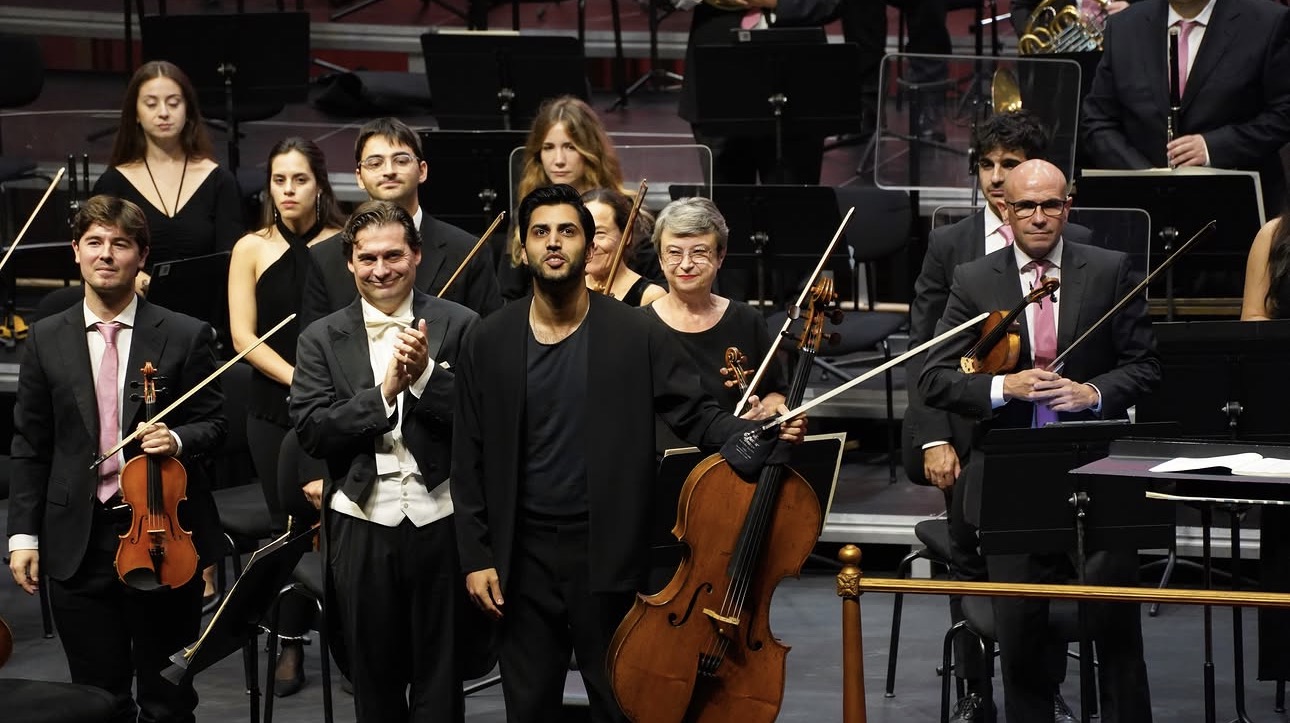
Kian Soltani and the OSIB, conducted by Pablo Mielgo, open the season at the Palma Auditorium with Elgar’s Cello Concerto and Richard Strauss’s Also sprach Zarathustra.
The Palma Auditorium reopened its doors to the Balearic Islands Symphony Orchestra with its refurbished seating area, comfortable and elegant, in harmony with its history. It did so with a young, familiar and acclaimed protagonist: Kian Soltani. Acclaimed, as his résumé demonstrates, and present on some of the world’s finest stages. Familiar because he has visited us three times: first at the Trui with Dvořák; then at Bellver Castle with Schumann; and most recently with Edward Elgar’s Cello Concerto in E minor, Op. 85.
A work of maturity, although perhaps there is no work by Elgar that does not seem so. What is beyond doubt is that, when he wrote it, his state of mind was one of infinite sorrow and desolation. Perhaps for that reason, the choice of the cello could not have been more fitting. Even so, the composition with which the composer bade farewell to symphonic music had to wait before finding the place it occupies today: among the instrument’s most canonical pieces.
Kian Soltani made this clear in the recitative that opens the composition: soft, light, subtle. The second movement continues with a series of repetitions between soloist and orchestra, like an exquisite contest, like two ways of expressing the same thing. In the Adagio, the third of the work’s four movements, the spotlight falls on the soloist, eliciting an immense display of talent and delicacy from Soltani, who crowned it with the opening section. The fourth movement, Finale, also requires the protagonist’s magnificence in an attempt to rise above the desolation, which ultimately returns to the place where it has breathed throughout this musical lament.
Soltani and the Symphony Orchestra, conducted by Pablo Mielgo, complemented each other perfectly in a score that demands absolute unity, which both achieved. There was the customary encore and, once again, a short composition celebrating his Persian roots.
I do not know what connection there might be between Elgar’s concerto and Richard Strauss’s multifaceted symphonic poem Also sprach Zarathustra, but both works are always welcome. The stratospheric introduction perhaps explains why it became emblematic when Stanley Kubrick used it almost sixty years ago in his monumental and labyrinthine 2001: A Space Odyssey. Nor was its origin simple: the philippic of a powerful Nietzsche.
The fact is that the two works have followed different, even divergent paths. A succession of fugues, counterpoints and modulations establishes an immense corollary, full of contrasts, in which we find everything from a waltz to a delicate cello solo, or a demonstration of just how important the timpani can be. Together, a cathedral-like mosaic, with an introduction and eight distinct sections, without any unevenness. A very fine opening instalment.